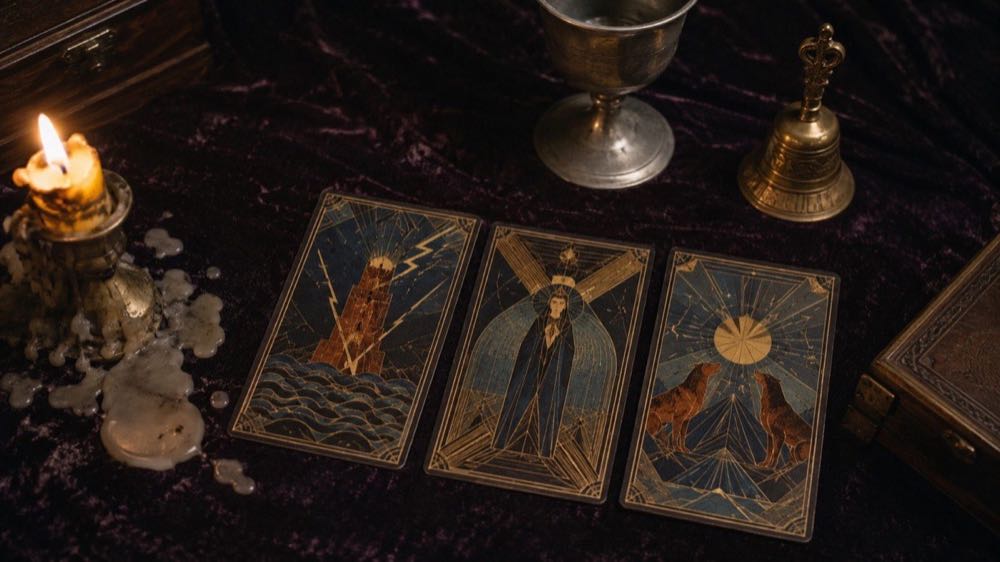
The Thoth Tarot is the most demanding of the major modern Tarot decks. It was conceived by Aleister Crowley in 1938 and painted between then and 1943 by Lady Frieda Harris, a British artist who had to learn the entire Western esoteric tradition during the painting in order to render the cards correctly. Crowley wrote the accompanying text, The Book of Thoth, while bedridden with bronchitis and morphine, and it was published in 1944. The deck itself was first printed in 1969, twenty-two years after Crowley's death — a delay tied to Crowley's persistent controversy and the post-war collapse of his publisher.
What you get when you hold the Thoth deck is the most fully integrated version of the Hermetic Order of the Golden Dawn system that exists in card form. Every card carries an astrological attribution, a Hebrew letter, a Sephirah, a path on the Tree of Life, and an elemental signature — and all of these correspondences are visible in the painting, not buried in the margins. The Harris paintings are also unlike any other Tarot art: Art Deco geometry, projective-geometry curves, and color theory drawn from her training under the geometer Paul Foster Case.
- Designed: Aleister Crowley, 1938 — painted: Lady Frieda Harris, 1938–1943, five years of work.
- The Book of Thoth (Crowley's text) was published in 1944; the deck was first published in 1969.
- Crowley renamed four of the 22 Major Arcana: Justice → Adjustment, Strength → Lust, Judgement → Aeon, World → Universe.
- The deck contains 78 cards total: 22 Major Arcana (Atu), 16 court cards (Knight, Queen, Prince, Princess of each suit), 40 numbered cards across Wands, Cups, Swords, Disks.
- The Golden Dawn astrological attributions assign each Major Arcanum a planet, sign, or element — and each Minor Arcanum to a decan of the zodiac. Crowley preserved these attributions intact. [Thoth Tarot]
The 22 Atu (Major Arcana)
The 22 Major Arcana of the Thoth deck — Crowley called them Atu, from a hypothetical Egyptian root — are:
- 0 The Fool · I The Magus · II The Priestess · III The Empress · IV The Emperor · V The Hierophant · VI The Lovers · VII The Chariot
- VIII Adjustment (was Justice) · IX The Hermit · X Fortune · XI Lust (was Strength) · XII The Hanged Man · XIII Death · XIV Art (formerly Temperance)
- XV The Devil · XVI The Tower · XVII The Star · XVIII The Moon · XIX The Sun · XX The Aeon (was Judgement) · XXI The Universe (was World)
The renamings are not cosmetic. Lust is not Strength — Crowley's card features Babalon riding the seven-headed Beast, and reads as ecstatic union with experience rather than the older "fortitude" virtue. Adjustment is not Justice — it points to dynamic balance and karmic equilibration rather than legalistic verdict. Aeon is not Judgement — Crowley's whole religious system is the Aeon of Horus, and the card is its initiation, not Christian eschatology. Universe is not World — it is the complete circuit, not just the terrestrial sphere.
How Arcana Origin uses the Thoth Tarot
Arcana Origin derives a primary Thoth Atu from your birth datum and reads it in the language of Crowley's Book of Thoth — cross-checked against Lon Milo DuQuette's Understanding Aleister Crowley's Thoth Tarot, which is the most reliable modern guide to the deck. The card lands alongside the other +100 readings in your chart.
What the Thoth deck adds to a synthesized reading that other tarot decks cannot is its integration with the Hermetic system as a whole. Because the Thoth deck encodes Golden Dawn astrological correspondences directly, your Thoth card will often agree with your Western tropical Sun sign or ruling planet — and when it does, the Convergence layer reports the agreement as it does for any other tradition match. It is the deck most likely to triangulate with the rest of your Western-tradition readings.
A note on Crowley
Aleister Crowley is one of the more polarizing figures in twentieth-century esoterica. His personal conduct included drug use, multiple breakdowns, a series of broken relationships, and antisemitic remarks in private correspondence. He has been variously characterized as a serious occult scholar, a self-promoting charlatan, and a generationally important religious innovator — sometimes all in the same essay. Arcana Origin does not arbitrate this. The deck is used here as a symbolic system on the strength of its Hermetic scholarship and Harris's artistic craft. The biographical complications are noted and not hidden.