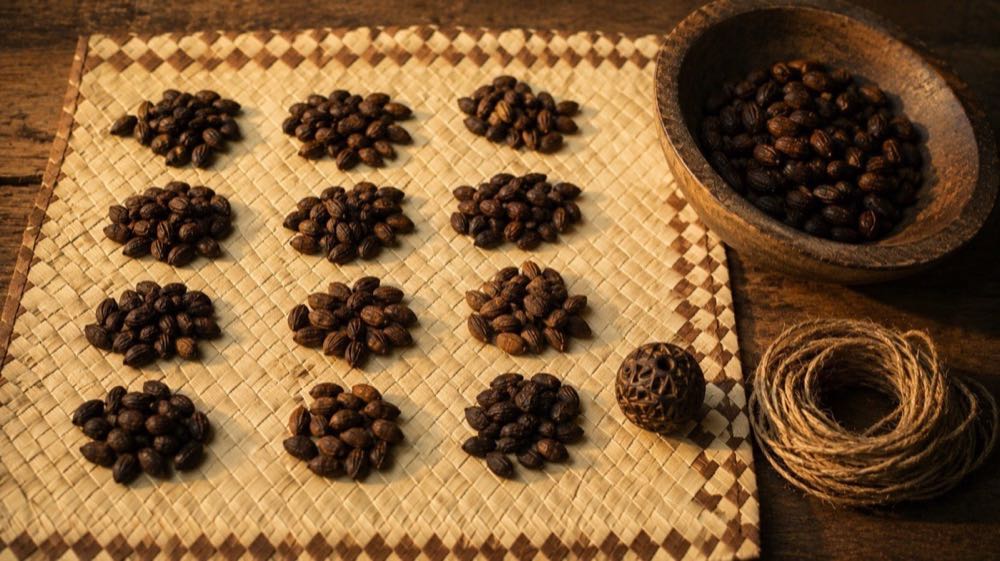
Sikidy is the divination tradition of Madagascar — a system of casting sixteen geomantic figures from piles of tree seeds, performed by a specialist diviner called an ombiasy. It is one of the more important living divination traditions of the Indian Ocean world, continuously practiced across Madagascar for what is likely close to a thousand years, and one of the least known outside the region. The system shares its sixteen-figure structure with Arabic geomancy (ilm al-raml), with European geomancy, and with West African Ifa-adjacent systems — the four traditions are siblings, not strangers — but sikidy's interpretive framework is fully its own, developed inside Malagasy cosmology over centuries.
Most Westerners reading about divination have never encountered sikidy. This is partly because Madagascar sits at a cultural intersection most Anglophone scholarship neglects (Bantu, Austronesian, Arab, Indian, Portuguese, and French influences all overlap there), and partly because the ethnographic literature on sikidy is mostly in French and Malagasy. Arcana Origin includes sikidy because it is one of the systems most worth recovering for general awareness.
- Origin: Madagascar, reaching the island via Arab and Swahili trade routes during the medieval period. The Malagasy names for several figures preserve Arabic linguistic roots, confirming the transmission.
- Practitioner: the ombiasy (or moaše in some regions), a specialist diviner whose role combines divination, healing, and ancestor mediation.
- Materials: seeds from the fano tree (Piptadenia chrysostachys) are most traditional; other small dark seeds are used regionally.
- Structure: sixteen geomantic figures, each composed of one or two seeds in four rows — the same sixteen figures used in Arabic, European, and Ifa-adjacent geomancy.
- Chart: the four Mothers (mother figures) generated by casting → eight Daughters derived by combination → four further figures completing the sixteen-position grid. [Sikidy]
How a sikidy casting works
The ombiasy poses a question — often on behalf of a client — then with eyes averted reaches into a heap of fano seeds and takes a handful. The handful is divided in two; one pile is set aside, the other is divided again, and the number of seeds in the final fraction (one or two) determines the first row of the first figure. This is repeated four times to generate four rows, completing one figure. Four such figures are generated — these are the Mothers — and from them the rest of the chart is derived by combination.
Once all sixteen positions are filled, the ombiasy reads the chart by position (which figure landed where), by relationship (which figures repeat or oppose), and by category (which Malagasy interpretive themes are activated). Different ombiasy lineages emphasize different aspects of the reading; the underlying figure-grid structure is consistent across the island.
The sixteen figures
The sixteen figures of sikidy are the same family as those used in Arabic and European geomancy, though their Malagasy names and primary attributions differ:
- Asoravavy, Asoralahy — strong figures of feminine and masculine principles
- Adabara, Tareky — figures of work, sustenance, journey
- Alikola, Alikisy — figures of breakthrough, conflict, change
- Karija, Bilady — figures of structure, inheritance, family
- Saka, Vontsira — figures of inquiry, hidden things, mystery
- And six further figures completing the sixteen-position system — each a binary pattern of one or two seeds in four rows.
The figures correspond systematically to those used in Arabic ilm al-raml — Asoravavy is structurally identical to Tariq, Adabara to Acquisitio, and so forth — but Malagasy interpretation has developed independent emphasis. The Malagasy categories of fady (taboo), aly (ancestor consultation), and vintana (destiny) are central to sikidy reading and have no direct equivalent in the Arabic or European traditions.
How Arcana Origin uses sikidy
Arcana Origin computes a complete sikidy chart from your birth datum, using a deterministic mapping that produces the same sixteen-figure grid an ombiasy would produce by casting. The chart is read in standard Malagasy interpretive vocabulary, drawn from the ethnographic scholarship of Philippe Beaujard, Ruth Trubek, and Lars Vig, with cross-reference to the underlying Arabic geomantic figure family.
Where sikidy earns its place in a synthesized reading is in its geographic and cultural distance from anything else you've encountered. When sikidy says the same thing about you that your Vedic chart or your Western tropical Sun sign already said, the Convergence layer takes the agreement seriously precisely because the systems developed independently across continents. Sikidy is the input you can be most sure isn't echoing something you already heard.
A note on respect
Sikidy is a living tradition with real practitioners doing real work for their communities in Madagascar today. Arcana Origin's automated reading is not a substitute for consultation with a working ombiasy. It is a tradition-included input among 94, intended for self-reflection at the scale of the chart, not for the kind of decisional consultation that happens when an ombiasy and a client sit together with a question.
If sikidy speaks to you, the right next step is to learn more about Madagascar, support Malagasy scholarship, and recognize that the system you're using has a culture of origin that deserves attribution and respect. Arcana Origin does not stand in for that.