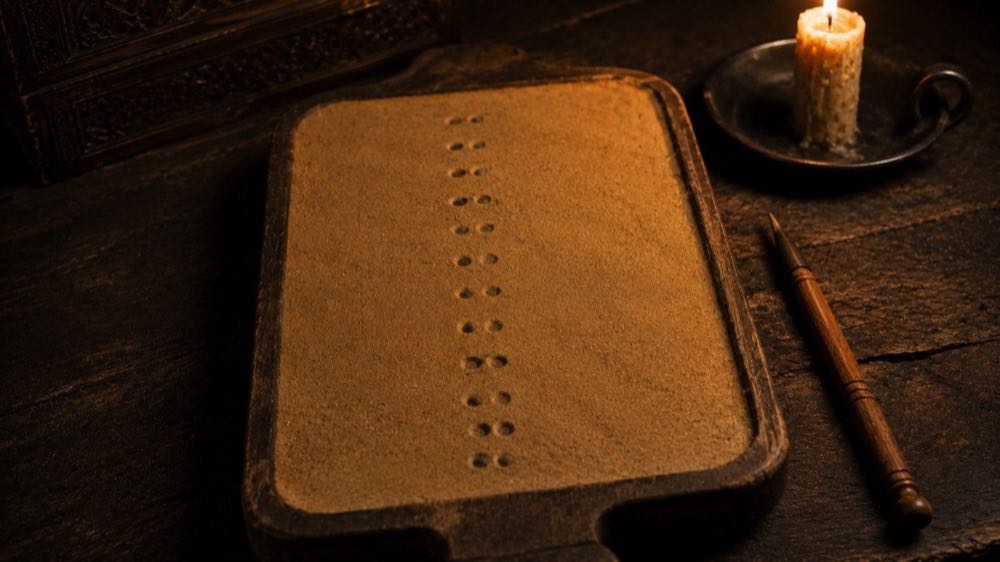
Geomancy is the divination system most American readers have never heard of, which is strange because for about 700 years it was one of the most widely practiced divination methods on three continents. The name comes from Greek geōmanteía — earth-divination — and refers to the original physical practice: jabbing a stick into sand or dirt to make rows of marks, then counting whether each row had an odd or even number, and translating the resulting pattern into one of sixteen named figures.
The system originated in the medieval Islamic world in the 9th century CE, was translated into Latin in the 12th century and spread through medieval and Renaissance Europe, and was practiced — possibly independently, possibly through shared ancestry — across West and Central Africa as the related systems known today as Ifa, Sikidy, and others. Every major Renaissance occult writer wrote on geomancy: Cornelius Agrippa, Robert Fludd, Christopher Cattan, John Heydon. By the seventeenth century it was as widely studied as astrology.
- The earliest surviving Arabic geomantic text is attributed to az-Zanati (12th century), building on a tradition already centuries old. [Geomancy · Wikipedia]
- Hugh of Santalla's 12th-century Latin translation introduced geomancy to Europe; by the 16th century it had its own Renaissance literature including Christopher Cattan's The Geomancie (1591), translated into English as a standalone textbook.
- The sixteen figures correspond to 16 of the I Ching's 64 hexagrams in their binary structure — a fact noted with interest by both Western and Chinese scholars who have studied the systems comparatively, though the historical relationship is debated.
- The African systems — Yoruba Ifa, Malagasy Sikidy — use the same binary figures but combine them into 256 (Ifa) or larger combinations, accompanied by oral verse corpora that constitute some of the largest unwritten literatures in the world.
How a traditional geomantic reading works
A reader holds a question in mind and makes sixteen rows of dots — usually four rows of four, sometimes other configurations. Each row is reduced to a single dot (odd) or two dots (even). The resulting figure of four rows is named, interpreted, and placed in a "shield chart" (or in later Renaissance practice, a horoscope-style chart). The figures interact in a structured way to produce the full reading.
The figures themselves are named and characterized:
- Via (the Way) — movement, journey, change
- Populus (the People) — gathering, crowd, public matters
- Fortuna Major (Greater Fortune) — substantial good fortune, especially in established matters
- Fortuna Minor (Lesser Fortune) — quick or temporary fortune, better for fast actions than slow ones
- Acquisitio (Gain) and Amissio (Loss) — material increase and decrease respectively
- Laetitia (Joy) and Tristitia (Sorrow) — emotional polarity
- Puella (the Girl) and Puer (the Boy) — receptive and assertive principles
- Albus (White) and Rubeus (Red) — peace and conflict, often paired with Mercury and Mars respectively
- Caput Draconis and Cauda Draconis (Head and Tail of the Dragon) — beginning and ending
- Conjunctio (Conjunction) — meeting, union, new association
- Carcer (the Prison) — confinement, structural limitation
How Arcana Origin uses geomancy
Arcana Origin derives a primary geomantic figure from your birth datum using a deterministic binary encoding. The figure is interpreted in its traditional Renaissance European meaning, with cross-reference to the medieval Arabic sources where the figures predate the European tradition, and placed in the Convergence layer alongside the other +100 readings.
Where geomancy is particularly useful is in its plainness. The figures do not describe psychological architecture or transcendent purpose. They describe conditions: gain, loss, prison, road, meeting, parting. When a chart loaded with Saturnian astrological signatures returns Carcer (the prison) as its primary geomantic figure, the geomancy is naming what the astrology was implying with restraint. The two traditions agreeing in plainer language than either uses alone is the Convergence layer at its most useful.