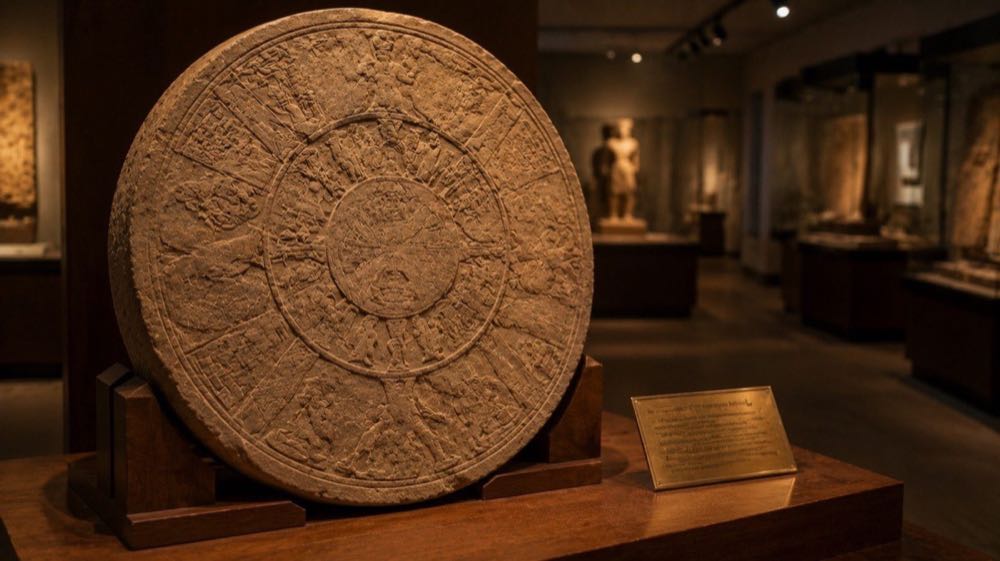
The "Egyptian zodiac" is one of the most widely shared astrological systems on social media — and one of the most historically misrepresented. The version that circulates online typically assigns twelve Egyptian deity names to twelve calendar segments, presents itself as ancient Egyptian wisdom, and claims roots in the temples of Karnak or Luxor. Almost none of this is documented in any surviving ancient Egyptian source.
The actual ancient Egyptian astrological system is the 36 decans, dating to roughly 2150 BCE, in which each decan is the ten-day rising of a specific star or asterism. The decans are documented on coffin lids from the First Intermediate Period, in the tomb of Senenmut (ca. 1473 BCE), in the Book of Nut, and on the ceiling of the Hathor temple at Dendera. The decans system is genuinely 4,000 years old. The deity-name twelve-sign zodiac is approximately fifty.
- The 36 decans are documented from ~2150 BCE (Middle Kingdom coffin lids), making them one of the oldest astrological systems on record.
- The Dendera Zodiac — a stone ceiling carving from the Temple of Hathor at Dendera, dated ~50 BCE — is real, but it depicts twelve Hellenistic Greek zodiac signs, not original Egyptian ones. It was carved during Ptolemaic Greek rule. The original is at the Louvre.
- The deity-name twelve-sign "Egyptian zodiac" (Nile, Amon-Ra, Mut, etc.) first appears in popular astrology books in the 1970s-1980s, then proliferated on the early internet and on social media after 2015.
- The twelve segments and the deity names do not correspond to documented Egyptian liturgical or astronomical calendars. Egyptian religious calendars used the heliacal rising of Sirius and the 36 decanal divisions, not a 12-sign zodiac.
- None of this disqualifies the modern system as a self-reflection tool. It just disqualifies the claim that it is ancient. [Dendera Zodiac] [Decans]
Where the modern version comes from
The 1970s pop-occult revival — paralleled by the broader New Age boom — produced several "ancient" systems that were not actually ancient. The deity-name Egyptian zodiac is one of them. The earliest popular books to assign twelve Egyptian deities to twelve calendar segments date to the 1970s and 1980s. Earlier French and German Egyptological scholarship — Wallis Budge, Selim Hassan, Otto Neugebauer — never describes any such system, because no such system existed in the surviving Egyptian record.
What did exist:
- The 36 decans — stars whose rising marked ten-day intervals across the year, each associated with a deity and astronomical body part of Nut.
- The civil calendar of 365 days — twelve months of thirty days plus five epagomenal days, with each month named for a festival not a sign.
- The Sothic cycle — the 1,461-year cycle of the heliacal rising of Sirius (Sopdet) relative to the civil calendar.
- The lunar festival calendar — a separate calendar of priestly observances.
None of these is a twelve-sign zodiac. The Greek twelve-sign zodiac arrives in Egypt during the Hellenistic period (after Alexander, 332 BCE) and is incorporated into local astronomical art — most famously in the Dendera ceiling.
What about the Dendera Zodiac?
The Dendera Zodiac is real. It is a circular stone ceiling carving from the Temple of Hathor at Dendera, carved during Ptolemaic Greek rule around 50 BCE. It depicts twelve Hellenistic zodiac signs surrounded by the 36 Egyptian decans and various Egyptian deities. It is one of the most beautiful celestial maps of the ancient world, and it sits in the Louvre today.
But the twelve-sign framework is Greek, not native Egyptian. The Greek zodiac arrived with Alexander and was carved by Egyptian artisans following Greek astronomical convention. The Dendera ceiling is a remarkable hybrid — a Greek system honored in Egyptian temple art — but it is not evidence of a native Egyptian twelve-sign zodiac.
How Arcana Origin handles this
Arcana Origin uses the 36 decans as its Egyptian-tradition input — the documented, attested ancient system. The deity-name twelve-sign "Egyptian zodiac" is not in the engine because it is not historically Egyptian. If you specifically want a deity-archetype reading, our Hermetic Order systems, our Tarot reading, and our Greek/Hellenistic tropical Sun sign do similar interpretive work using systems whose origins are not misrepresented.
The Convergence layer will surface where your Egyptian decan agrees with your Western tropical Sun sign — and when it does, you can think of that as the closest legitimate echo of "Egyptian zodiac" intent: a real ancient Egyptian system speaking the same theme as your familiar Western reading.