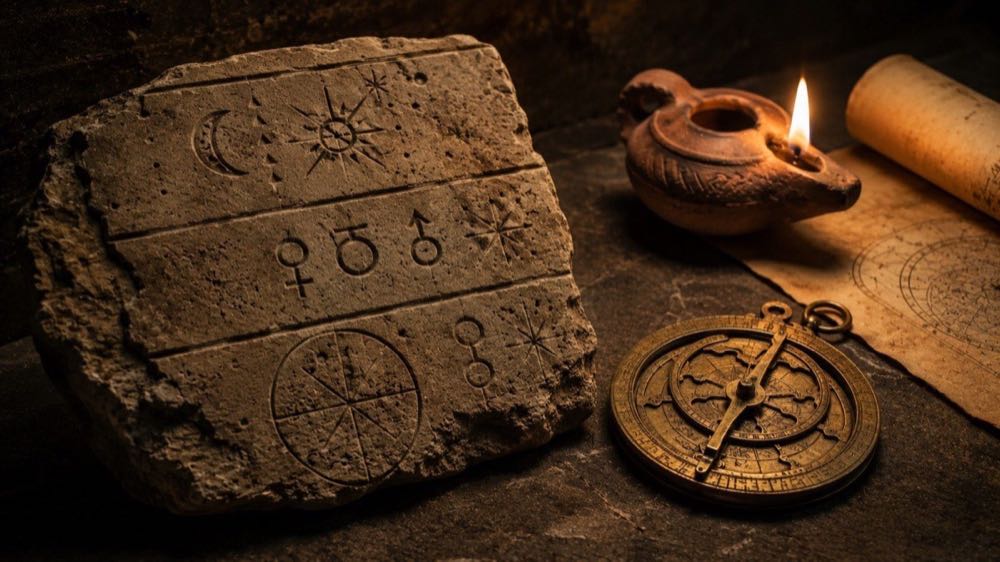
The Egyptian decans are not the "Egyptian zodiac" you may have met in a magazine quiz — twelve signs named for Egyptian gods like Thoth and Horus and Bastet. That system is a 20th-century invention. The actual Egyptian astronomical and ritual tradition was much older, much more rigorous, and much less zodiacal in the modern sense. It was a system of thirty-six decans, each governing ten days of the year, each associated with a specific star or star-group whose heliacal rising marked the beginning of its period.
The earliest surviving record of the decan system is painted on coffin lids from the First Intermediate Period (ca. 2150-2000 BCE) and in detail in the Senenmut tomb ceiling from the early New Kingdom (ca. 1473 BCE) — making it one of the oldest documented astronomical-religious frameworks in human history. The decans tracked the night sky over the agricultural Egyptian year and were tied to specific gods, hours of the night, and protective deities — every ten-day period had its own constellation-overseer.
- The Egyptian civil calendar was 360 days + 5 epagomenal days = 365 days. The 360-day portion was divided into 36 decans of 10 days each. [Decan · Wikipedia]
- The Egyptian "hour" was originally defined by the rising of successive decans across the night sky — making the decans the original timekeeping framework that gave us the twenty-four-hour day (twelve hours of daylight + twelve hours of night, the latter measured by decan-risings).
- By the Hellenistic period in Alexandria (ca. 300 BCE-100 CE), the decans had been absorbed into the developing twelve-sign zodiac. Each sign received three decans of ten degrees, each governed by a classical planet — a system preserved in Vettius Valens' Anthology and Hephaistio of Thebes' surviving texts.
- The decans appear prominently on the Dendera Zodiac (Ptolemaic-era stone relief, now in the Louvre) — the most famous single artifact of Greco-Egyptian astrology.
The structure
Each decan is associated with a star or constellation in the Egyptian sky-map, a god or protective spirit, an hour of the night, and a body of associated symbolic meanings. The decans cycle continuously through the year. The decan that ruled the ten days of your birth is your natal decan, and is interpreted as a sign that runs alongside (and sometimes within) your zodiacal sign.
The Hellenistic-era assignment of planets to decans — Mars to the first decan of Aries, Sun to the second, Venus to the third, and so on through the planetary order — is the form most modern astrologers will recognize. This is the form Arcana Origin uses to bridge Egyptian and Western traditions.
How Arcana Origin uses the decans
The decan layer in Arcana Origin's reading does three things:
- Specifies your decan within your zodiacal sign — if you are an Aries, are you the first, second, or third decan? Each has a different classical planetary ruler and different traditional image.
- Connects you to the Egyptian sky-map — what star or star-group rose at the beginning of your ten-day window? The decan tradition was originally about which specific stars were ruling the night when you were born.
- Adds the Greco-Egyptian magical-symbolic layer — each decan in the Hellenistic tradition has associated images, sometimes called paranatellonta ("rising-alongside"), preserved in texts like the Picatrix (medieval Arabic compilation drawing on Hellenistic sources).
In the Convergence layer, the decan often refines what the zodiac sign was already saying. A Capricorn first decan (ruled by Jupiter in the Chaldean order) is structured differently from a Capricorn third decan (ruled by the Sun). When other traditions agree on the planetary signature suggested by the decan, the engine reports it as a doubled signal.
The honest scholarship note
The decan tradition has a long history but the surviving sources are uneven. The Egyptian original — coffin lids, tomb ceilings, ritual texts — gives the structure but does not give detailed character interpretations of each decan. Most of the elaborate "decan readings" in circulation today are drawn from Hellenistic and medieval Arabic sources that systematized the Greco-Egyptian fusion, not from continuous Egyptian transmission. Arcana Origin uses the Hellenistic interpretive layer (Vettius Valens, Hephaistio, the Picatrix) with full acknowledgment that this layer is itself an interpretive tradition, not a direct read of the ancient Egyptian original.