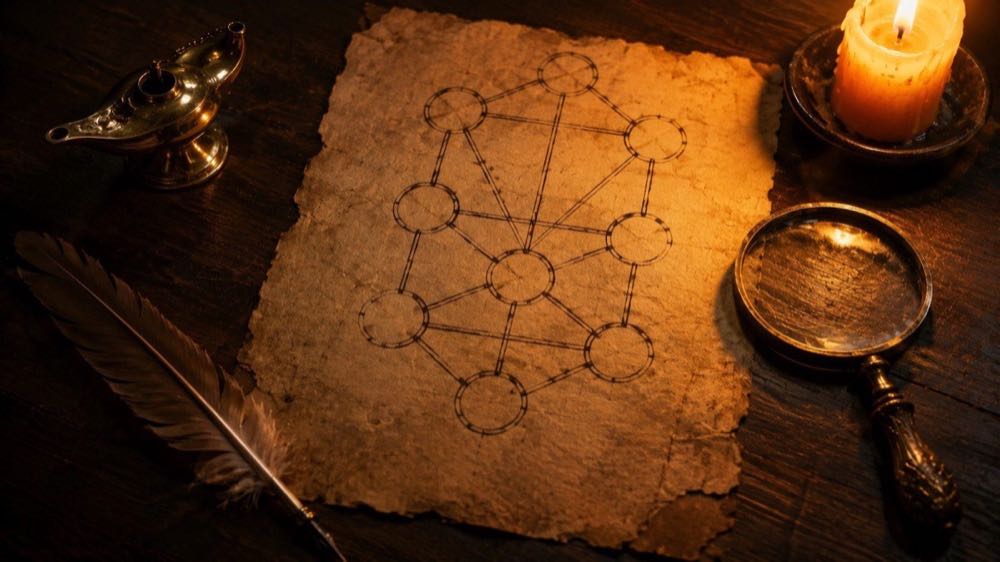
The Tree of Life is the central visual structure of Kabbalistic thought — and, by extension, of the entire Western esoteric tradition that drew from Kabbalah. It is a diagram of ten Sefirot, or divine emanations, arranged in three vertical columns connected by twenty-two paths. Each Sefira is a quality through which the unknowable infinite (Ein Sof) becomes knowable. Each path between Sefirot is a route of consciousness, traditionally identified with one of the twenty-two letters of the Hebrew alphabet.
Most modern readers meet the Tree through its Hermetic adaptation — the version refined by the Golden Dawn in the late nineteenth century, in which each Sefira is associated with a planet, a tarot card, an angelic correspondence, and a body of symbolic associations. That Hermetic Tree is what Arcana Origin uses, with full acknowledgment that it is not identical to the Tree as practiced inside traditional Jewish Kabbalah.
- The earliest text to name the ten Sefirot — the Sefer Yetzirah (Book of Formation) — dates between the 2nd and 6th centuries CE. [Sefer Yetzirah]
- The diagram of the Tree with twenty-two connecting paths was formalized in the Zohar (Book of Splendor), written or compiled in late-13th-century Castile, traditionally attributed to Moses de León.
- The Hermetic Kabbalistic interpretation that maps Sefirot to planetary energies was systematized by the Hermetic Order of the Golden Dawn in 1888-1900, drawing on Christian Kabbalist writers including Athanasius Kircher and Knorr von Rosenroth.
- Twentieth-century writers including Aleister Crowley, Dion Fortune, Israel Regardie, and Gershom Scholem made the Tree central to modern Western occultism and academic Kabbalistic scholarship respectively — operating on the same diagram from very different angles.
The structure
The Tree's ten Sefirot are arranged from top to bottom in descending order of emanation:
- Keter (Crown) — the unknowable source, first emanation
- Chokmah (Wisdom) — pure creative impulse
- Binah (Understanding) — receptive form, the structuring intellect
- Chesed (Mercy) — expansive love, Jupiter
- Geburah (Severity) — necessary limitation, Mars
- Tiferet (Beauty) — integration, the Sun
- Netzach (Victory) — desire, Venus
- Hod (Splendor) — articulation, Mercury
- Yesod (Foundation) — the unconscious, the Moon
- Malkuth (Kingdom) — the manifest world, Earth
The three vertical columns are called pillars: the right (Mercy — Chokmah, Chesed, Netzach), the left (Severity — Binah, Geburah, Hod), and the middle (Mildness — Keter, Tiferet, Yesod, Malkuth). A person whose chart maps primarily to the right pillar is structured differently from a person on the left or middle. The pillars are temperamental, not moral.
How Arcana Origin uses the Tree
Arcana Origin derives a primary Sefira and a primary pillar from your birth datum using the Hermetic planetary correspondences. If your chart is governed by Saturn, your primary Sefira is Binah; by Jupiter, Chesed; by Mars, Geburah; by the Sun, Tiferet; and so on through the planetary set. The pillar follows from the Sefira.
The Sefira is interpreted in its traditional commentary — what Tiferet means as a quality of consciousness, what Chesed signals about how a person extends themselves outward, what Hod means about the use of language and analysis — and then placed alongside the other +100 readings. If your Vedic chart names you as a Jupiterian, your Mayan day-sign points to Ahau (the Sun, completion), and your I Ching hexagram is Tài (Peace, integration), the Tree of Life independently lands you near Tiferet — the central Sefira of integration on the middle pillar. Four traditions agreeing on the same theme is the Convergence layer at its strongest.
Sefirot, Sephirah, and the spelling problem
Two spellings of the same word appear constantly in English-language Kabbalah literature: Sefirot (plural) and Sephirah (singular). Sometimes also Sephiroth (older transliteration of the plural). All three refer to the same Hebrew word — ספירות / ספירה — meaning "countings" or "enumerations" or, in the technical Kabbalistic sense, "emanations." The spelling difference is purely a transliteration choice across different translators and traditions.
Conventionally: modern academic and Hermetic writers use Sefirah / Sefirot (closer to modern Hebrew pronunciation). Older Christian Kabbalist and Golden Dawn writers use Sephirah / Sephiroth (closer to older Latinized transliteration). Either is correct. You will find both in Arcana Origin's own writing because both spellings are valid and we don't think the choice matters as much as some Kabbalistic schools insist.
Each Sefira in deeper detail
The ten Sefirot are not interchangeable categories. Each one is a specific quality of consciousness with specific traditional associations. The ones most likely to land as your primary Sefira:
- Keter (Crown) — the first emanation, identified with the divine will itself. Very rarely a primary Sefira because it represents the unconditioned source rather than a manifest quality.
- Chokmah (Wisdom) — the first creative impulse, pure outward force. Associated with the Zodiac as a whole, paternal generative energy, the right pillar.
- Binah (Understanding) — receptive structuring intelligence. Associated with Saturn, maternal form-giving, deep contemplative time.
- Chesed (Mercy) — expansive benevolence. Associated with Jupiter, generosity, hospitality, the right pillar of Mercy.
- Geburah (Severity) — necessary limitation and discipline. Associated with Mars, judgement, courage, the left pillar of Severity.
- Tiferet (Beauty) — integration and balance. Associated with the Sun, the heart, the integrated self. Often considered the most accessible Sefira.
- Netzach (Victory) — desire and impulse. Associated with Venus, art, the persistence of love through difficulty.
- Hod (Splendor) — articulation and analysis. Associated with Mercury, language, the structured mind.
- Yesod (Foundation) — the unconscious and the dream. Associated with the Moon, sexuality, the foundation that supports the manifest world.
- Malkuth (Kingdom) — manifestation itself, the physical world. Associated with the Earth, the body, the place where the Tree is read from.
A reading that names Chesed as your primary Sefira is not the same as a reading that names Geburah. The first says you are structured to expand and give; the second says you are structured to limit and discipline. Both are valuable; both have their failure modes (overgiving versus overrestricting); knowing which is yours changes how you read the rest of your chart.
Ain Soph — what stands above the Tree
Above the Tree itself stand three veils of the unmanifest — three layers of what exists before any emanation. Together they describe what Kabbalah holds about the source from which the Sefirot themselves emerge:
- Ain (אין) — "Nothing." The absolute negation. Not the absence of something but the prior condition that allows anything at all.
- Ain Soph (אין סוף) — "Without End" or "Limitlessness." Sometimes rendered "the Infinite." The pure unbounded existence from which the boundedness of the Sefirot is drawn.
- Ain Soph Aur (אין סוף אור) — "Limitless Light." The first stirring toward emanation, the light by which Keter (the first Sefira) becomes possible.
These three veils are not Sefirot themselves. They stand above the Tree as the conditions for the Tree to exist at all. Traditional Kabbalah holds them as essentially unspeakable — they can be named but not described, since description belongs to the Sefirot which they precede.
Why this matters for a birth reading: the Tree describes the qualities your consciousness manifests within creation. The veils describe what stands behind creation as a whole. No human being has a "primary veil" — the veils are not personal categories. They appear in this page because the search for "Ain Soph" often arrives at the same audience reading about the Sefirot, and the relationship deserves to be named: the Sefirot are what becomes visible; the Ain Soph is what they emerge from.
What the Tree is good for
The Tree's particular usefulness in a multi-tradition reading is structural. Where astrology speaks in archetypes (Sun, Moon, planets) and the I Ching speaks in scene-language (hexagrams as images), the Tree speaks in topology. It tells you where you sit in a map of consciousness — which qualities you naturally embody, which you reach for, and which you have to work hardest to reach. A person whose center of mass is in Geburah (Severity) is structured to discipline and limit, and is correctly read when the rest of the chart's themes are filtered through that structural fact.
This is why the Tree is one of the most useful single traditions in a synthesized reading: it gives the engine a map that the other traditions can be placed on. Vedic gives the karmic content; the Tree gives the architectural shape that the karmic content is being expressed through.