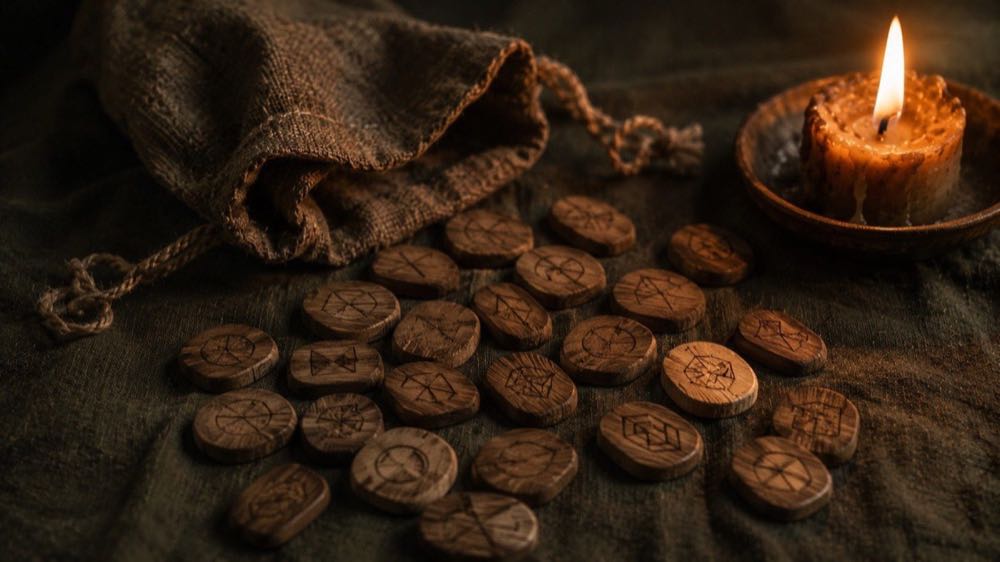
The runes are the letters of the Germanic alphabets — the script in which Norse, Anglo-Saxon, and Gothic peoples carved everything from grave markers and amulets to inventories of livestock and bawdy graffiti, for nearly a thousand years before Christianization replaced them with the Latin alphabet. The oldest and most widely studied runic alphabet is the Elder Futhark — twenty-four runes, organized into three rows of eight called aettir, each row attributed to a Germanic deity.
What separates runes from a normal alphabet is that each rune is also a name, and each name carries weight. The first rune, Fehu, is named for cattle and means wealth. The eighth, Wunjo, names joy. The fifteenth, Algiz, names protection. The runes were used for writing and for casting — for inventory and for inquiry — in the same hand by the same people, and the line between the two uses was never clearly drawn.
- The earliest known runic inscriptions — the Vimose finds in Denmark — date to approximately 160 CE, making the Elder Futhark roughly 1,860 years old. [Elder Futhark]
- Three medieval rune poems — the Old English Rune Poem (ca. 9th century), Old Icelandic Rune Poem (ca. 15th century), and Old Norwegian Rune Poem (ca. 13th century) — are the primary historical sources for traditional rune meanings.
- Tacitus, writing in his Germania in 98 CE, described divinatory casting of marked wooden lots among the Germanic tribes — predating the earliest surviving runic inscriptions and suggesting an older oral tradition.
- The Elder Futhark was succeeded by the Younger Futhark (16 runes, 8th-12th c. Scandinavia) and the Anglo-Saxon Futhorc (29-33 runes, 5th-11th c. England) — Arcana Origin uses the older 24-rune Elder Futhark.
The three aettir
The twenty-four runes are organized into three rows of eight:
- Freyr's aett (runes 1-8) — Fehu, Uruz, Thurisaz, Ansuz, Raidho, Kenaz, Gebo, Wunjo. Themes of substance, vitality, force, journey, and exchange.
- Heimdall's aett (runes 9-16) — Hagalaz, Nauthiz, Isa, Jera, Eihwaz, Perthro, Algiz, Sowilo. Themes of necessity, time, mystery, and protection.
- Tyr's aett (runes 17-24) — Tiwaz, Berkano, Ehwaz, Mannaz, Laguz, Ingwaz, Dagaz, Othala. Themes of justice, growth, alliance, and inheritance.
Each aett describes a kind of work: substance-work, mystery-work, and social-work, in that order. A reader whose primary rune falls in Heimdall's aett is structured around a relationship to necessity that Freyr's-aett readers do not share. Knowing the aett is half of knowing the rune.
How Arcana Origin uses the runes
Arcana Origin derives a primary rune from your birth datum and an associated aett. The rune is interpreted in the language of the medieval rune poems — the only historical sources for traditional rune meanings — alongside reconstructive scholarship from Stephen Pollington, R. I. Page, and Stephen Flowers. The result enters the Convergence layer like any other tradition.
Where the runes are particularly useful in a synthesized reading is in their directness. The runes do not offer subtle psychological language. They name forces: wealth, need, ice, harvest, the auroch, the journey. When astrology says you are a Capricorn with Saturn in the first house and the rune Isa (ice, stillness, holding-pattern) appears in the same chart, the rune is saying the same thing in fewer words. That kind of stripped-down agreement is the Convergence layer at its clearest.
A note on reconstruction
Unlike the Vedic, Chinese, or Mayan traditions, the runic tradition was largely broken by Christianization. There is no continuous lineage of practitioners from the 10th century to the modern era. Everything done with runes today is, to some degree, reconstructed from the medieval poems, the surviving inscriptions, and Tacitus. This is not a disqualifying fact — reconstruction is what the Greek classical tradition has always done — but it should be named. The runes Arcana Origin uses are the runes as recovered, not as continuously transmitted.