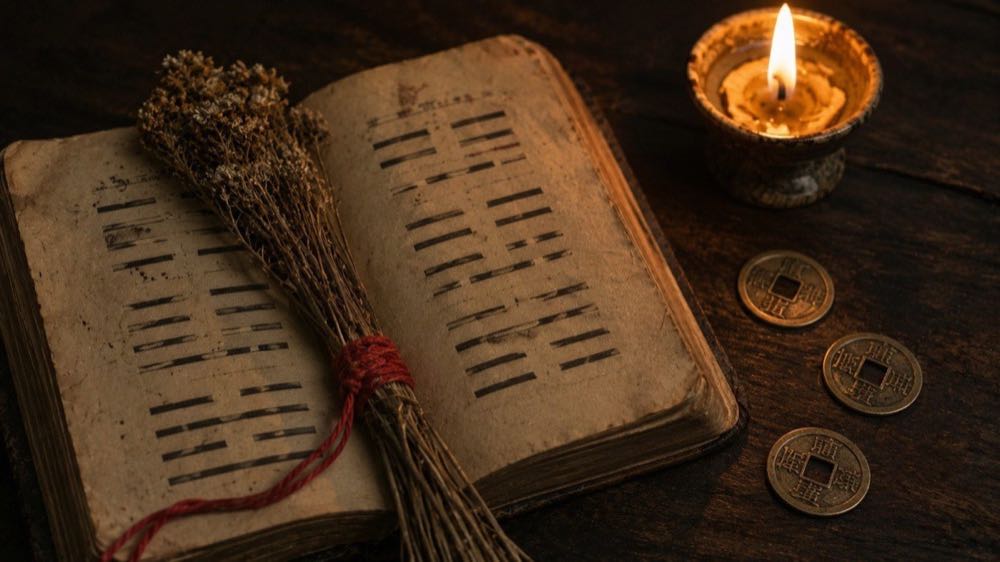
The I Ching — sometimes written as Yijing, or in English the Book of Changes — is one of the oldest continuously consulted divination texts in the world. It consists of 64 figures called hexagrams, each made of six stacked horizontal lines that are either solid (yang) or broken (yin). Every hexagram has a name, a traditional image, and a body of commentary developed across more than two thousand years of Chinese philosophical and political life.
If you have only met the I Ching as a fortune-cookie app or a TikTok overlay, the actual text will surprise you. It does not predict. It does not say this will happen. It says this is the character of the moment you are standing in, and this is the kind of action that the moment is asking for. Read in that frame, it becomes one of the most subtle decision-support documents ever assembled.
- The I Ching's earliest stratum, the Zhou Yi, dates to the Western Zhou dynasty (ca. 1000-750 BCE) [I Ching · Wikipedia].
- The text consists of 64 hexagrams × 6 lines = 384 line statements, plus an extensive layered commentary called the Ten Wings, traditionally attributed to Confucius and his school.
- The Richard Wilhelm translation (1924), rendered into English by Cary Baynes (1950), carries a foreword by Carl Jung introducing the concept of synchronicity to Western readers.
- The I Ching has been continuously cited by figures including Bob Dylan, Philip K. Dick, Hermann Hesse, John Cage, and Terence McKenna — making it one of the most cross-pollinating texts in Western counterculture.
How a traditional reading works
Classically, an I Ching reading is cast by one of two methods: three coins (six tosses, each producing one line of the hexagram), or yarrow stalks (a longer ritual using fifty stalks, taught in the Ten Wings). The reader holds a question in mind during the casting. The resulting hexagram corresponds to one of 64 chapters in the King Wen sequence. Some readings produce a primary hexagram only; others produce a primary hexagram plus a changing hexagram that signals where the situation is moving.
The interpretation is not "your hexagram says X." The interpretation is the encounter between the hexagram's image, the reader's question, and the reader's life as it presently stands. A skilled I Ching reader treats the text as a counsel — not a verdict.
How Arcana Origin uses the I Ching
In Arcana Origin's reading, the I Ching enters as one of +100 readings applied to your single birth datum. The engine derives a primary hexagram from your date and time of birth using a deterministic correspondence rule — the same rule applied to every reader — so the result is reproducible. The hexagram is then interpreted in two layers:
- The traditional commentary on the hexagram itself — drawn from the Legge translation and the Chinese original, with Arcana's own modern line beside it.
- The hexagram's relationship to the other +100 readings — the Convergence layer notes where the I Ching's image agrees with, contradicts, or extends what Vedic Jyotish, Chinese Bazi, Mayan Tzolkin, or Western tropical astrology say about the same person.
If three or four traditions independently land on a theme — say, the necessity of a structural decision held off for years — the Convergence reports it as a high-confidence signal. The I Ching's contribution to that confidence is its image-language: where astrology speaks in archetypal vocabulary, the I Ching speaks in scene-language. "The well." "Treading on the tail of the tiger." "After completion." These images are not better or worse than the astrological vocabulary — they describe a different layer of the same situation.
The Jung framing — synchronicity, not prediction
Carl Jung's 1949 foreword to the Wilhelm-Baynes edition introduced a concept he had been developing for decades: synchronicity, or "acausal connecting principle." Jung's claim was that the I Ching does not work because future events are encoded in coin tosses; it works because the moment of casting and the moment of the question being asked share a common character that an experienced reader can perceive through the hexagram as through any other revealing surface.
This framing matters because it dissolves the usual objection to divination ("but the coins are random"). Synchronicity does not require causal influence from the future. It requires only that the moment have a character — and that the moment's character can be reflected as readily in a hexagram as in a dream image, a slip of the tongue, or the song that comes on the radio when you sit down to write something difficult.
Arcana Origin's use of the I Ching follows Jung's framing. The engine does not claim that your hexagram predicts your future. It claims that your hexagram, taken alongside +100 other readings of the same birth moment, gives you a richer view of the moment you entered the world inside of.
Sample hexagram in context
Hexagram 11 in the King Wen sequence is called Tài — "Peace," sometimes translated as "Greatness" or "Heaven and Earth Unite." It shows three yang lines below three yin lines: heaven (creative) below earth (receptive), the energies flowing toward each other rather than away. Legge's translation: "the little gone and the great come; there will be good fortune, with progress and success."
For a reader whose Vedic chart shows Jupiter strongly placed and whose Mayan Tzolkin day-sign is Ahau (the Sun, completion, illumination), Tài's appearance is no surprise — the three traditions independently report a person whose work in this life is to bring upper and lower together, to mediate, to translate. The Convergence layer reports this as a high-confidence vocational theme, citing the three traditions that converged.
If the same person's reading had returned hexagram 12, Pǐ — "Standstill" or "Stagnation," the inverse of Tài — and Vedic and Mayan still reported integrative themes, the Convergence would report a different and more interesting signal: a person whose integrative work is currently blocked by a structural condition the I Ching is naming directly. That kind of cross-tradition contradiction is where the engine's value is highest.