Feng shui means “wind and water.” The name goes back to a line in the Book of Burial, attributed to the fourth-century scholar Guo Pu: qi rides the wind and scatters, and it is held where it meets water.[1] The first masters read hillsides. Later the same eye turned indoors, to the question people bring to it now: why does this room feel wrong, and what should I move?
The classical answer is less mysterious than the internet makes it look. A good practitioner spends the first ten minutes of a visit ignoring your birth date and the compass. They stand in the doorway and look. Where is the light? Can you see the back door from the front one? What is behind the bed? The compass comes later, if at all.
This is a field guide to that way of looking, with the personal layer on top: your Kua number and the flying stars of 2026. Science treats feng shui as a traditional practice rather than a measurable force,[1] so read it as a tradition with its own logic.
Two schools under one name
Classical feng shui has two broad branches. The Form School reads shape: the land, the building, the room and the furniture in it. Is there support behind you? Does energy pool or rush? The Compass School reads direction and time. It holds the two systems this article leans on: Eight Mansions (Ba Zhai), which gives each person four favourable and four unfavourable directions, and Flying Stars (Xuan Kong Fei Xing), which tracks nine numbered stars as they move through a building year by year.
Most Western books teach something else. The bagua map of the Black Sect Tantric Buddhist school (BTB), founded by Thomas Lin Yun (1932–2010), lays a nine-square grid over a room, aligned to the front-door wall, with no compass and no birth data. Wikipedia files it among the “Westernised or modern methods not based on Classical teachings.”[1] Both schools use the word bagua for different sets of directions, so laying the two over one floor plan produces advice that contradicts itself.[8] Crystals are a separate matter: a modern Western add-on, absent from the classical texts. Keep them if you love them; just don’t call them classical.
The order of repairs
On the sequence, practitioners come close to consensus.
Light first. A dark room is the most common problem and the cheapest to solve. Open what opens, and put a lamp in the corner that goes dim by four in the afternoon. A room without light holds stagnant qi, and no furniture plan fixes that.
Then break the straight lines. When the front door lines up with a window or a back door, qi is said to come in and leave without circulating. A rug, a plant or a screen set partway along the line slows it down.
Then put a wall behind every important seat. Where you sleep, work and rest should have something solid at your back. The old landscape language calls it the Black Tortoise, the hill behind the house. Indoors it means a headboard against a wall and a sofa that isn’t floating in open space with the door behind it.
Compass direction last. Only when the room is lit, the path slowed and your back covered does it make sense to ask which way the bed points. Most people start here. A perfect direction in a dark room with the door behind you is still a dark room with the door behind you.
Room by room
The bedroom
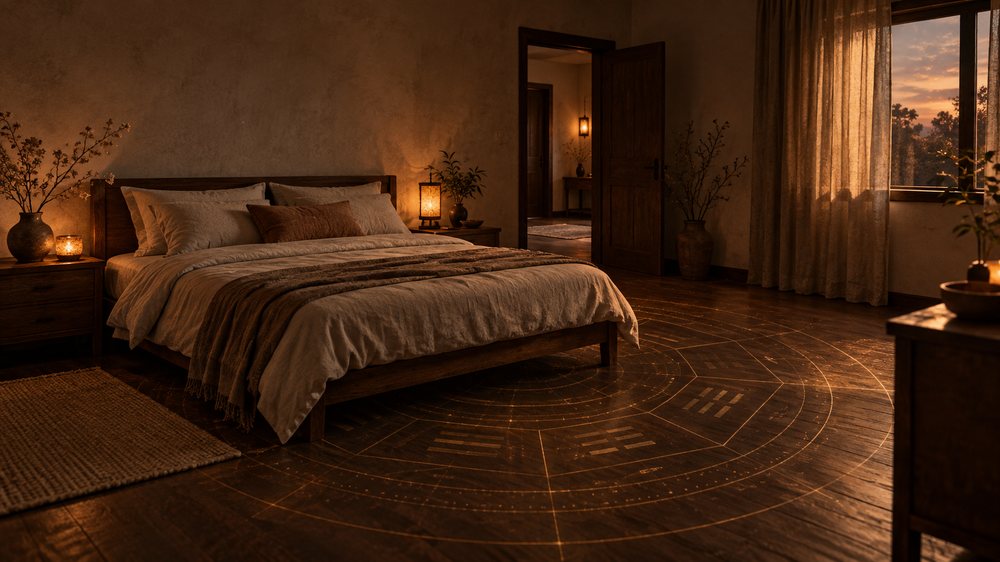
The bed goes against a solid wall. From the pillow you should see the door, but the bed should not sit in a straight line with it. Nothing heavy hangs over you: no exposed beam, no shelf, no chandelier. And no mirror faces the bed, one of the most repeated rules in the tradition. A mirror, the usual explanation goes, returns a room’s movement at the hour you want it to settle.
The desk
Back to a wall, door in view. This is the command position, and most people feel it within a day. What you don’t want behind your chair is anything open or moving: a window, a corridor, a staircase.
The entry
The front door is where qi enters the house. There should be no straight run from it out through the back door. And no mirror should face it directly, since by the same logic a mirror sends whatever arrives straight back out.
The kitchen
The stove is the fire of the house and gets the same courtesy as the bed: a solid wall behind it. It should not be visible from the front door, and stove and sink should neither face each other nor sit side by side. The reasoning comes from the five elements, where Water controls Fire.[2] The same theory offers the bridge: Water feeds Wood and Wood feeds Fire, so a plant or something wooden between them is the usual answer when the kitchen is already built.
The wealth corner
Here the schools part ways. In Form School practice the wealth position is the corner diagonally across from the door as you enter. By compass it is the Southeast, the palace of Xun, trigram of wind and wood. On the BTB map it is the back-left corner seen from the doorway.[8] What the three share is the treatment. Keep the corner lit, give it a solid wall behind, keep something living there (a healthy plant is the classic choice), and leave out water features and mirrors. It is not a financial promise, just a corner you have decided to look after.
Your Kua number
The personal layer starts with one number, your Kua (卦), taken from your year of birth.[4] Two details trip up most calculators online.
The first is the year boundary. A feng shui year begins at Li Chun, the start of spring, when the Sun reaches 315° of ecliptic longitude. That lands on 3, 4 or 5 February (in 2026 it was 4 February, 04:02 Beijing time), not on 1 January or at Chinese New Year. Born in January or early February? You belong to the previous year.
The second is the year 2000, where the hand method changes. Add the last two digits of your solar birth year and reduce to one digit: for 1985, 8 + 5 = 13, and 1 + 3 = 4. Before 2000, a man subtracts that digit from 10 and a woman adds 5, reducing again if needed, so 1985 gives a man Kua 6 and a woman Kua 9. From 2000 on, a man subtracts the digit from 9 and a woman adds 6: for 2005, a man is Kua 4 and a woman (6 + 5 = 11) is Kua 2. There is no Kua 5. A man who lands on it takes 2, a woman takes 8.[4] Calculators that skip the 2000 switch misplace everyone born this century. The formula also works from sex at birth, a binary the tradition never questioned.
Your number puts you in a group. The East group (Kua 1, 3, 4, 9) finds its favourable directions in the North, South, East and Southeast. The West group (Kua 2, 6, 7, 8) finds them in the West, Northwest, Southwest and Northeast.
The eight directions
Eight Mansions then names each direction.[5] The favourable four, in rank order: Sheng Qi, “generating breath,” for vitality and momentum; Tian Yi, “heavenly doctor,” a direction of renewal; Yan Nian, “extended years,” for harmony in partnership; and Fu Wei, “hidden position,” your own direction, for steadiness. The other four are Huo Hai (mishaps, the mildest), Wu Gui (“five ghosts,” friction), Liu Sha (“six killings,” entanglements) and Jue Ming (“severed fate,” the least favourable). Careful practitioners read these theatrical old names as tendencies, nothing more.
Each Kua gets its own compass. Kua 1, for example, has Sheng Qi in the Southeast, Tian Yi in the East, Yan Nian in the South, Fu Wei in the North and Jue Ming in the Southwest. Once light, lines and backing are settled, this decides which way the desk faces and which wall takes the headboard.
The Lo Shu and the stars of 2026
Flying Stars adds time. Its map is the Lo Shu, a three-by-three magic square in which every row, column and diagonal adds up to 15. With South at the top, as Chinese diagrams draw it, the square reads 4, 9, 2 along the south, 3, 5, 7 across the middle from East to West, and 8, 1, 6 along the north. Each number is also a direction and an I Ching trigram: 1 is North and Kan, water; 9 is South and Li, fire.[3]
Each year nine stars move through those palaces in a fixed order. We are in Period 9 (2024–2043), whose ruling star is the 9 Purple, a fire star.[7] 2026 is a Fire Horse year, bing wu, running from Li Chun on 4 February 2026 to 3 February 2027, with the 1 White in the centre:[6]
| SE9 | S5 | SW7 |
| E8 | Centre1 | W3 |
| NE4 | N6 | NW2 |
Read conservatively: the Southeast holds the 9, the timely star of the whole period, in the sector the compass school already treats as the wealth corner. Keep it bright and in daily use. The South holds the 5 Yellow, the strongest affliction in the system, and in a Horse year it is also the seat of the Tai Sui, the Grand Duke of the year. Practitioners take that as a reason for restraint in the South, not alarm. The North carries the year’s other afflictions, the Three Killings and the Sui Po, alongside the 6 White, the star of authority.[6]
The Northwest has the 2 Black, which the annual charts count among the afflictions. The West has the 3 Jade, the quarrel star, and the Northeast the 4 Green, star of study and romance. The 8 in the East is retreating now that Period 8 is over, and the 7 in the Southwest is past its period.[7] None of this is a forecast, only a map of where to be careful and where to spend attention.
What a camera can see
A consultant reads rooms in person, with a luopan, the feng shui compass. Most of us can only hold a phone up in a doorway. That is the idea behind The Reading of Your Rooms, a Feng Shui practice sealed in the Oracle for now and coming soon. You will photograph a bedroom, a desk, an entry or a wealth corner, and the Oracle will read it against your Kua number and this year’s flying stars, then tell you what to move, turn or clear, in the order described here.
Until then, the order costs nothing. Stand in your doorway tonight and look at the light, then the line, then the wall behind the bed. To see the five elements read a person instead of a room, try our piece on BaZi and the Day Master. And The Convergence looks at what happens when separate traditions point at the same thing.