Moon Phase Today
The Moon as it is right now: its phase, how much of it is lit, the sign it is crossing, and the next turns of the cycle in your own time zone.
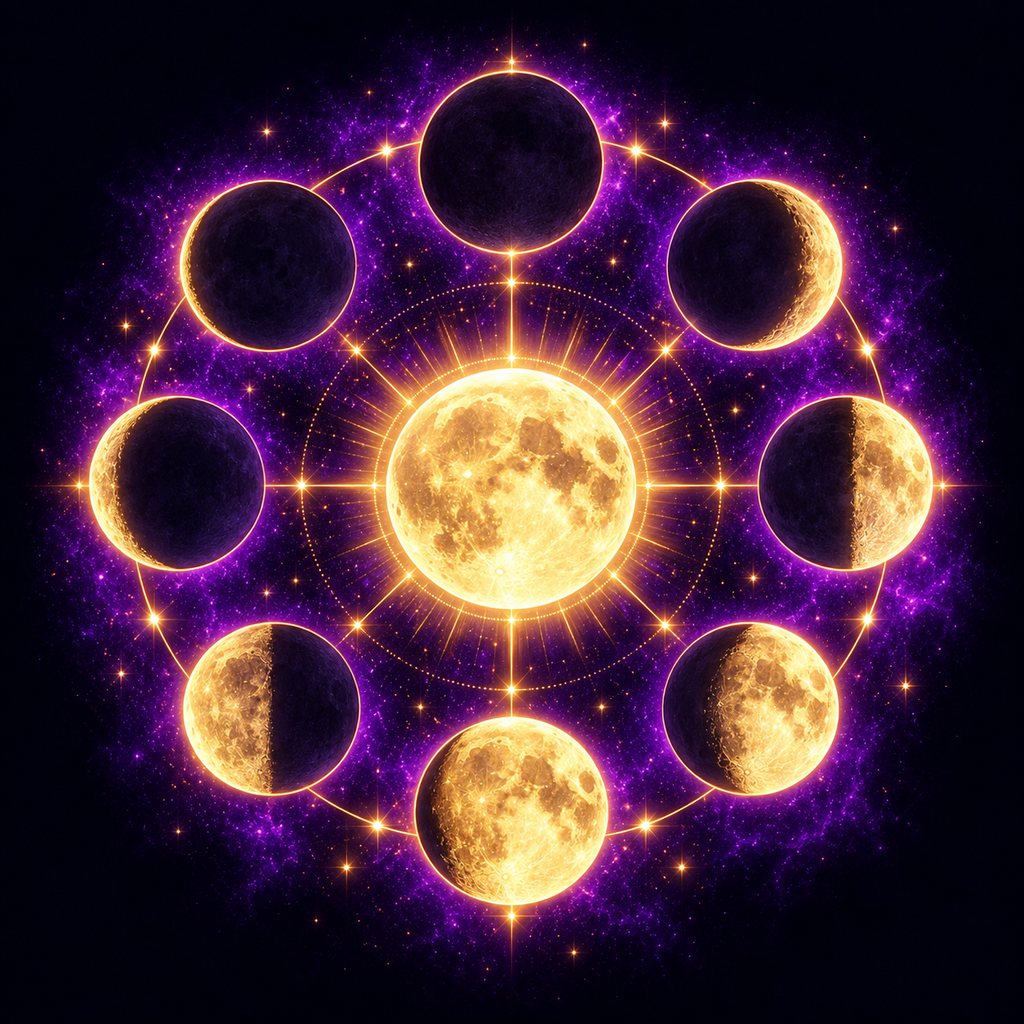
A lunar phase is a matter of angle. Half of the Moon is always lit by the Sun; what changes is how much of that lit half faces us. When the Moon sits between Earth and the Sun, its bright side points away and we see a new moon. A quarter of the way around, a quarter-turn from the Sun, half the disc is lit: the first quarter. Opposite the Sun it shows its whole face as the full moon, and three quarters of the way round it is half-lit again at the last quarter.
The full cycle takes about 29.5 days, two days longer than the Moon needs to orbit Earth once, because Earth moves along its own path around the Sun in the meantime and the Moon has to catch up to the same angle. Along the way the Moon is also the fastest traveller in the zodiac, covering about 13 degrees a day and changing sign every two and a half days or so.
Astrologers follow both rhythms. The Moon sign is read as the emotional weather of the day, the new moon as a natural point to begin something and the full moon as a point of culmination, when things come into the open. You don't have to take any of that on faith to find the rhythm useful. Many people simply like knowing where the Moon is.
How this is computed
Everything here is computed live in your browser from Astronomy Engine, which agrees with NASA JPL Horizons to within seconds of arc. The phase is the angle between the Moon and the Sun as seen from the centre of Earth, and the illumination is the fraction of the disc that is lit. The Moon's sign and degree use its apparent geocentric longitude in the tropical zodiac, the same frame as a Western birth chart. The moment of a new or full moon is the same everywhere on Earth; only the clock time changes with your time zone, and this page uses yours.
A principal phase is named on the calendar day its exact moment falls; other days carry the in-between names, such as waxing crescent or waning gibbous. Eclipses come from the same library. A lunar eclipse can be seen from anywhere the Moon is above the horizon at the time, while a solar eclipse is seen only along its path, so the solar listing gives the point of greatest eclipse.
Reading the drawing
The drawing shows the Moon as it looks from the Northern Hemisphere, lit from the right while it waxes. South of the equator the picture is mirrored, so tick the box above if that's where you are. We tick it for you when your time zone is clearly southern.
Frequently asked
What phase is the Moon in today?
The panel at the top of this page works it out live from your device's clock: the phase name, the percentage of the disc that is lit, and how many days have passed since the last new moon. On the day of an exact new moon, quarter or full moon, it also gives the minute that phase is exact in your time zone.
Is a first quarter moon a quarter lit?
No, it is half lit. The name refers to the Moon being a quarter of the way through its cycle, not to how much of it shines. Illumination climbs from 0% at new moon to 50% at first quarter and 100% at full moon, then falls back the same way.
What sign is the Moon in today?
The top of the page shows the Moon's sign and exact degree right now, plus the moment it moves into the next sign. Because the Moon covers about 13 degrees a day, it changes sign roughly every two and a half days, which is why the Moon sign is one of the most talked-about daily placements in astrology.
When is the next full moon?
Full moons come about every 29.5 days. The list above gives the next full moon, along with the next new moon and both quarters, in your local time and with the sign the Moon will be in. Use the date lookup to check any other day between 1900 and 2100.
Why does my calendar show the full moon on a different day?
The full moon is a single instant for the whole planet. If it happens at 1:00 in the morning in London, it is still the previous evening in New York, so printed calendars from different countries can disagree by a day. This page converts the instant to your own time zone.
How often do eclipses happen?
Several times a year. An eclipse needs a new or full moon close to one of the two points where the Moon's orbit crosses the Sun's path, and that lines up in two eclipse seasons roughly six months apart. Most years bring four or five eclipses, though only some are visible from any one place.
Which Moon were you born under?
Tonight's Moon is the same for everyone. The Moon you were born under is yours alone. Arcana Origin places it, with every planet, at the moment of your birth and reads your chart across many traditions.
Cast your full reading →